English
 Español
  Português
  русский
  Français
  日本語
日本語  Deutsch
  tiếng Việt
  Italiano
  Nederlands
  ภาษาไทย
  Polski
  한국어
한국어  Svenska
  magyar
  Malay
Malay  বাংলা ভাষার
  Dansk
Dansk  Suomi
Suomi  हिन्दी
  Pilipino
  Türkçe
  Gaeilge
  العربية
  Indonesia
  Norsk
Norsk  تمل
تمل  český
český  ελληνικά
  український
  Javanese
  فارسی
فارسی  தமிழ்
தமிழ்  తెలుగు
  नेपाली
  Burmese
  български
  ລາວ
ລາວ  Latine
  Қазақша
  Euskal
  Azərbaycan
  Slovenský jazyk
  Македонски
  Lietuvos
  Eesti Keel
  Română
  Slovenski
  मराठी
मराठी  Srpski језик

EPIC provides the CNC Automatic Dosing Machine for Industry for demanding industrial production environments where consistent reagent proportioning, continuous operation, and automated process control are essential. Designed around CNC digital control, industrial-grade components, and modular construction, the equipment supports applications including mineral processing, chemical manufacturing, environmental treatment, and industrial raw-material processing.
Industrial dosing directly affects product consistency, process stability, reagent consumption, and operating costs. Manual and semi-automatic dosing can introduce human error and become difficult to manage during long production cycles. A CNC-controlled dosing system provides fixed-value automatic dosing, real-time parameter adjustment, and more consistent process management. EPIC's industrial model is designed for high-load, continuous production, combining wear-resistant dosing valves, anti-interference electrical components, an industrial touchscreen terminal, and a modular structure. With configurations from 6 to 90 channels, the system can be matched to different production scales and process requirements.
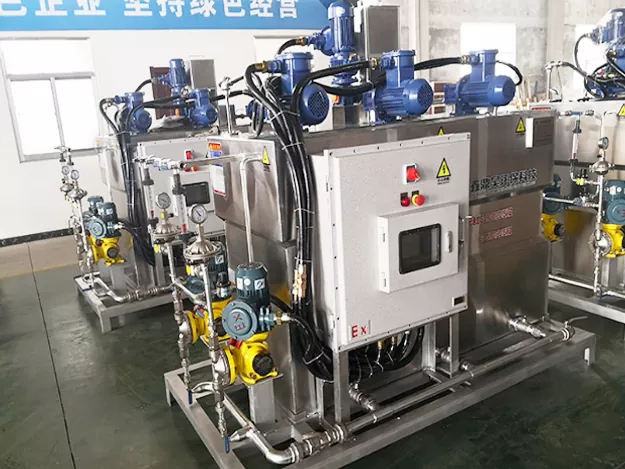
Table of Contents
- Why Is Automated Dosing Important in Modern Industry?
- How Does CNC Automatic Dosing Technology Work?
- What Are the Key Features of an Industrial CNC Dosing System?
- What Models and Configurations Are Available?
- Where Can Industrial CNC Dosing Machines Be Used?
- What Production Benefits Can Manufacturers Expect?
- How Should the Equipment Be Maintained?
- How Should Manufacturers Select the Right Dosing System?
- Frequently Asked Questions
- Conclusion
Why Is Automated Dosing Important in Modern Industry?
Dosing is a critical operation in many industrial processes. Whether a plant is adding flotation reagents, chemical raw materials, wastewater-treatment chemicals, or processing auxiliaries, the amount and frequency of each addition can influence downstream process performance.
Traditional manual dosing depends heavily on operator experience and repeated measurement. This approach may become inefficient when production volumes increase or when a process operates continuously. An automated dosing system transfers these repetitive operations to programmed controls, helping production teams establish a more standardized dosing workflow.
The industrial design of EPIC's equipment focuses particularly on long-cycle production. Its structure is intended for high-load operating environments, while the CNC control system supports fixed-value dosing and production parameter adjustment. This combination makes automated dosing more suitable for industrial processes where repeatability and operational continuity matter.
- Reduces dependence on manual dosing operations
- Improves batch-to-batch consistency
- Supports continuous industrial production
- Helps control excessive reagent consumption
- Provides centralized monitoring and parameter adjustment
How Does CNC Automatic Dosing Technology Work?
A CNC automatic dosing system combines programmable control logic with dosing valves, electrical components, and an operator interface. Before production begins, dosing quantities and operating parameters can be configured according to the process requirements.
During operation, the controller coordinates the dosing sequence according to preset values. Industrial dosing valves then deliver the required material or reagent, while the operator can monitor production parameters through the industrial touchscreen terminal.
This digital approach creates a repeatable workflow: parameter setting → automated dosing → process monitoring → parameter adjustment. When raw-material characteristics or production requirements change, operating parameters can be modified without relying entirely on manual intervention.
For large-scale production, this type of automation can also be integrated into a broader production line, allowing dosing operations to become part of a standardized industrial process rather than an isolated manual task.
What Are the Key Features of an Industrial CNC Dosing System?
Industrial CNC Constant-Value Control
Programmable industrial controllers support fixed-quantity and fixed-frequency dosing. This helps maintain consistent reagent proportions between production batches and provides a more predictable dosing process.
Enhanced Anti-Interference Design
Industrial production environments may involve vibration, dust, temperature fluctuations, and electrical interference. Industrial-grade circuit components and solid-state relays are used to improve operational stability under these conditions.
Wear-Resistant Dosing Valves
Dosing valves are important to long-term dosing consistency. The industrial configuration uses wear-resistant components designed to maintain stable dispensing performance during extended operation.
Intelligent On-Site Operation
An industrial touchscreen terminal provides a practical interface for production personnel. Operators can modify parameters, review production information, and monitor equipment status directly at the production site.
Modular Industrial Construction
The modular structure makes the equipment easier to configure and maintain. Reinforced wear components are intended to withstand frequent operation while reducing unnecessary replacement and downtime.
What Models and Configurations Are Available?
Different factories have different dosing-channel and production requirements. EPIC offers multiple configurations, allowing the system to be matched with smaller workshops as well as larger integrated industrial projects.
| Model | Power | Configuration | Typical Positioning |
|---|---|---|---|
| CDJ-2006-6 | 1.5 kW | 6 | Compact industrial dosing |
| CDJ-2006-8 | 2.2 kW | 8 | Small production systems |
| CDJ-2006-12 | 3 kW | 12 | Medium industrial applications |
| CDJ-2006-16 | 4.5 kW | 16 | Multi-channel dosing |
| CDJ-2006-24 | 7.5 kW | 24 | Large production lines |
| CDJ-2006-36 | 11 kW | 36 | High-capacity industrial processes |
| CDJ-2006-48 | 15 kW | 48 | Integrated production systems |
| CDJ-2006-58 | 18 kW | 58 | Large-scale process control |
| CDJ-2006-90 | 30 kW | 90 | Complex multi-channel projects |
The final configuration should be selected according to the number of dosing points, process flow, reagent characteristics, production capacity, and required integration with the existing production line.
Where Can Industrial CNC Dosing Machines Be Used?
The versatility of automated dosing makes it relevant to several industrial sectors where accurate and repeatable material addition is required.
Mineral Processing
Beneficiation plants frequently require controlled reagent addition during flotation and other separation processes. Automated dosing can help maintain consistent reagent proportions throughout extended production cycles.
Chemical Manufacturing
Chemical production often involves precise formulation and repeatable material ratios. CNC-based dosing provides programmable control for standardized production batches.
Environmental Treatment
Industrial wastewater treatment and other environmental processes may require continuous addition of treatment chemicals. Automated dosing can reduce manual intervention and support consistent process operation.
Industrial Raw-Material Processing
Building materials, metallurgy, and other processing industries may use auxiliary reagents during purification, separation, and fine processing. A programmable dosing system can be incorporated into these workflows.
What Production Benefits Can Manufacturers Expect?
The primary value of industrial dosing automation is not simply replacing manual operation. Its greater contribution is creating a repeatable and manageable production process.
- More Consistent Batch Production: Fixed-value CNC control helps reduce variations caused by manual dosing.
- Better Continuous-Operation Capability: Industrial-grade components are designed for demanding production schedules.
- Lower Reagent Waste: Controlled dosing helps prevent unnecessary over-addition and associated material consumption.
- Reduced Manual Intervention: Automated sequences allow operators to focus on monitoring and process management.
- Improved Equipment Availability: Reinforced components and modular construction can simplify maintenance and reduce avoidable downtime.
These benefits are particularly relevant when a factory moves from small-batch or semi-automatic production toward standardized, continuously operated production lines.
How Should the Equipment Be Maintained?
Even a highly automated dosing system requires systematic maintenance. Proper maintenance helps preserve dosing stability and supports long-term equipment availability.
- Calibrate dosing regularly: Establish a calibration schedule based on production cycles and process requirements.
- Clean dosing pipelines: Remove residual reagents and sediment before accumulation causes blockages.
- Inspect electrical components: Check circuits, relays, connections, and control components for abnormal operating conditions.
- Monitor wear parts: Inspect dosing valves and other high-use components and replace them when necessary.
- Review CNC parameters: Adjust control settings when raw materials, process conditions, or production targets change.
A preventive maintenance plan is generally more effective than waiting for a dosing problem to interrupt production.
How Should Manufacturers Select the Right Dosing System?
Choosing an industrial dosing machine should begin with the production process rather than simply the equipment's nominal capacity. Buyers should evaluate several technical factors before confirming a configuration.
| Selection Factor | Key Question |
|---|---|
| Dosing points | How many materials or dosing channels must be controlled? |
| Production schedule | Will the equipment operate intermittently or continuously? |
| Reagent characteristics | Are the materials corrosive, abrasive, viscous, or prone to sedimentation? |
| Control requirements | Are fixed-value dosing and real-time parameter changes required? |
| Production integration | Must the system connect with an existing automated production line? |
| Working environment | Will vibration, dust, temperature, or electrical interference affect operation? |
For customized industrial projects, manufacturers should also discuss process flow, installation conditions, required dosing accuracy, control architecture, and maintenance expectations with the equipment supplier before ordering.
Frequently Asked Questions
What is a CNC Automatic Dosing Machine for Industry?
It is an automated industrial dosing system that uses CNC digital control logic to manage fixed-value and programmed dosing operations. It is designed for standardized, repetitive dosing in demanding production environments.
Can an industrial CNC dosing system operate continuously?
The industrial configuration is designed for long-cycle and high-intensity operation. Its reinforced structure, wear-resistant dosing valves, and anti-interference electrical design are intended to support continuous industrial production.
What industries use automated dosing equipment?
Typical applications include mineral processing, chemical manufacturing, industrial environmental treatment, metallurgy, building-material processing, and other production processes that require controlled reagent or auxiliary-material addition.
How many configurations are available?
EPIC lists configurations ranging from CDJ-2006-6 through CDJ-2006-90, covering 6 to 90 configuration points with power ratings from 1.5 kW to 30 kW. The appropriate model depends on the production process and dosing requirements.
Can the dosing parameters be changed during production?
Yes. The CNC control system supports real-time production parameter adjustment, allowing operators to respond to process changes and variations in production conditions.
Can EPIC customize the machine for a specific production line?
Yes. EPIC states that it can provide model configuration and process optimization according to production scale, process flow, reagent types, and specific industrial requirements.
Conclusion
Industrial dosing is becoming increasingly connected with process automation, production consistency, and resource management. A CNC-controlled dosing system can help manufacturers move away from repetitive manual dosing toward a more standardized and controllable workflow. With industrial-grade components, programmable control, wear-resistant dosing valves, modular construction, and multiple configurations, EPIC's solution is designed for mineral processing, chemical manufacturing, environmental treatment, and other demanding industrial applications.
If you are evaluating an automated dosing solution for a new production line or upgrading an existing process, provide your dosing requirements, production capacity, reagent information, and process conditions to EPIC. Contact us for a suitable configuration, customized industrial dosing solution, and technical support for your project.