English
 Español
  Português
  русский
  Français
  日本語
日本語  Deutsch
  tiếng Việt
  Italiano
  Nederlands
  ภาษาไทย
  Polski
  한국어
한국어  Svenska
  magyar
  Malay
Malay  বাংলা ভাষার
  Dansk
Dansk  Suomi
Suomi  हिन्दी
  Pilipino
  Türkçe
  Gaeilge
  العربية
  Indonesia
  Norsk
Norsk  تمل
تمل  český
český  ελληνικά
  український
  Javanese
  فارسی
فارسی  தமிழ்
தமிழ்  తెలుగు
  नेपाली
  Burmese
  български
  ລາວ
ລາວ  Latine
  Қазақша
  Euskal
  Azərbaycan
  Slovenský jazyk
  Македонски
  Lietuvos
  Eesti Keel
  Română
  Slovenski
  मराठी
मराठी  Srpski језик

EPIC, a China-based mining machinery manufacturer and supplier, develops the Spiral Sand Washer for Coarse Stones for aggregate producers that need stable removal of mud, clay, and surface impurities from large-particle stone materials. Its widened washing cavity, large-pitch spiral, reinforced structure, and high-flow water system are designed specifically for demanding coarse aggregate applications.
Coarse stones require more than conventional sand washing because their larger particle size, higher individual weight, and stronger surface adhesion can create material accumulation, incomplete cleaning, and equipment wear. A purpose-designed spiral washer addresses these challenges through an expanded washing cavity, optimized spiral geometry, enhanced impact resistance, high-volume water distribution, and an anti-blockage discharge structure. EPIC provides several models with processing capacities ranging from 30 to 240 t/h, helping aggregate plants select equipment according to material characteristics and production requirements.
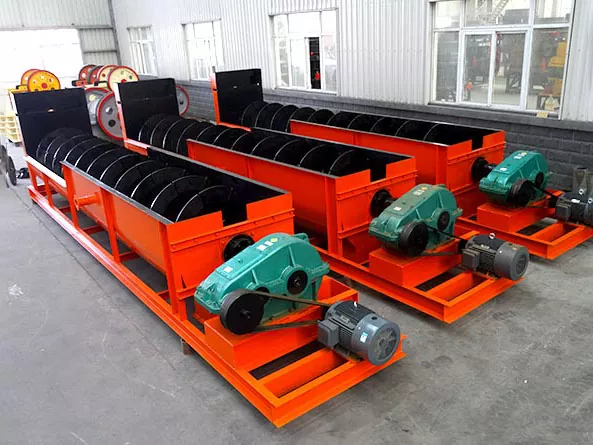
Table of Contents
- Why Does Coarse Stone Washing Matter?
- How Does a Spiral Sand Washer for Coarse Stones Work?
- What Structural Features Improve Washing Performance?
- What Are the Main Technical Parameters?
- What Advantages Can Aggregate Producers Expect?
- Where Is Coarse Stone Washing Equipment Used?
- How Should You Select the Right Model?
- How Can Operators Maintain Stable Performance?
- Frequently Asked Questions
Why Does Coarse Stone Washing Matter?
Coarse aggregates are commonly produced through crushing and screening processes. During extraction, transportation, crushing, and stockpiling, stone surfaces can become covered with clay, mud, dust, and other unwanted materials. If these impurities are not adequately removed, they can affect aggregate cleanliness and downstream processing performance.
Compared with fine sand, coarse stones have larger particle sizes and heavier individual particles. They also require sufficient space to move, flip, and contact with washing water. Conventional equipment with a narrow washing cavity or relatively small spiral pitch may therefore experience material accumulation or incomplete cleaning when processing large stones.
A specialized washing solution focuses on three core requirements:
- Provide enough internal space for large aggregates to move freely.
- Create sufficient mechanical agitation and water scouring.
- Transport cleaned material continuously without unnecessary blockage or particle damage.
How Does a Spiral Sand Washer for Coarse Stones Work?
The basic washing principle combines spiral mechanical movement with water-based scrubbing. Coarse stones enter the washing trough and are continuously stirred and propelled by the rotating spiral assembly. At the same time, a large-flow water supply helps loosen and remove mud, clay, and floating impurities from the stone surface.
The spiral movement is particularly important because it keeps the aggregate moving through the washing chamber rather than allowing large particles to settle in one location. During this process, stones are repeatedly flipped and exposed to water, improving contact between the material and the washing medium.
After washing, the spiral conveying action moves the cleaned aggregate toward the discharge end, while muddy wastewater and suspended impurities are separated through the overflow arrangement. This creates a continuous washing and conveying process suitable for industrial aggregate production.
What Structural Features Improve Washing Performance?
Expanded Washing Cavity
A widened and deepened trough provides additional movement space for large stones. This helps reduce material stacking and gives coarse aggregates enough room to turn over during washing.
Widened-Pitch Spiral Blades
The large-pitch spiral configuration is adapted to the movement characteristics of coarse particles. It supports continuous material propulsion while reducing the possibility of particles becoming trapped between spiral sections.
Reinforced Impact-Resistant Structure
Large stones can generate considerable impact and extrusion forces during continuous processing. Reinforced bearing and structural components help the machine withstand these operating conditions and maintain stable mechanical performance.
High-Flow Water Distribution
Water plays a critical role in removing clay and mud. The high-flow distribution arrangement creates stronger washing and scouring action, particularly when treating materials with relatively high surface contamination.
Anti-Blockage Discharge Design
The optimized outlet and overflow arrangement promotes smooth material discharge while allowing muddy wastewater to leave the washing chamber efficiently.
What Are the Main Technical Parameters?
EPIC offers several standard configurations to accommodate different production capacities and coarse stone processing requirements. The main models include:
| Model | Processing Capacity | Power | Recommended Application |
|---|---|---|---|
| LX-915 | 30–100 t/h | 15 kW | Small and medium-sized coarse aggregate cleaning |
| 2LX-915 | 60–200 t/h | 15 × 2 kW | Mixed coarse stone batch processing |
| LX-1115 | 40–120 t/h | 22 kW | Large-particle coarse stone washing |
| 2LX-1115 | 80–240 t/h | 22 × 2 kW | Large-scale continuous aggregate production |
Actual model selection should consider more than nominal capacity. Material size distribution, mud content, required washing intensity, feeding conditions, available water, and the overall production-line layout can all influence the final configuration.
What Advantages Can Aggregate Producers Expect?
1. More Effective Surface Cleaning
The combination of spiral agitation and high-flow water helps remove stubborn mud and clay from coarse aggregate surfaces. This is especially useful when the incoming material contains significant surface contamination.
2. Better Protection of Aggregate Shape
Coarse aggregate should be cleaned without unnecessary crushing or excessive mechanical damage. Optimized spiral speed and internal geometry provide controlled movement while maintaining the integrity of the stone particles.
3. Reduced Material Accumulation
The enlarged washing chamber and unobstructed material passage are designed around the physical characteristics of large particles. This can help minimize accumulation and blockage during continuous operation.
4. Continuous Production Capability
Spiral conveying allows washing and material transportation to occur within the same processing stage. This makes the equipment suitable for continuous aggregate production lines where stable material flow is important.
5. Adaptability to Difficult Raw Materials
Materials containing relatively high levels of mud or sticky surface contaminants can place additional demands on washing equipment. A larger washing cavity and strong water-scouring action provide a practical approach to these processing conditions.
Where Is Coarse Stone Washing Equipment Used?
The equipment can be integrated into several mineral and aggregate processing environments where clean coarse material is required.
- Crushed Aggregate Production: Removes surface contaminants from machine-made coarse stone before subsequent production stages.
- Road Construction: Provides cleaned aggregate for road bases, pavement-related applications, and highway infrastructure.
- Water Conservancy Projects: Supports aggregate preparation for dam foundations, slope protection, and related construction projects.
- Mining Material Processing: Helps clean coarse mineral aggregates and improve the quality of downstream material handling.
- Large-Scale Aggregate Plants: Supports continuous washing where stable throughput and controlled material flow are required.
For buyers planning a complete processing line, the washer can be evaluated together with crushing, screening, conveying, and other material-processing equipment. This approach allows the washing capacity to be matched with the actual production rate of the complete plant.
How Should You Select the Right Model?
Choosing a washer based only on its maximum stated capacity can result in an unsuitable configuration. A more practical selection process begins with the characteristics of the actual feed material.
- Define the required throughput. Estimate the normal and peak tons-per-hour requirement rather than relying only on the theoretical production target.
- Check particle characteristics. Record the approximate particle size, size distribution, density, and percentage of oversized material.
- Assess mud and clay content. Higher contamination generally requires stronger washing conditions and appropriate water management.
- Evaluate the available water supply. Water flow and recycling arrangements should be considered when designing the washing circuit.
- Review the complete plant layout. Feeding height, discharge position, conveyor arrangement, and available installation space can influence equipment selection.
- Discuss customization requirements. Spiral configuration, washing cavity dimensions, water distribution, and other details may be optimized according to specific material conditions.
EPIC states that it can recommend equipment according to coarse stone particle size, mud content, and required production output, helping users avoid model mismatches and unnecessary operating limitations.
How Can Operators Maintain Stable Performance?
Regular maintenance is essential when processing abrasive and heavy coarse aggregates. A practical maintenance routine should include:
- Inspect spiral blades regularly for wear caused by continuous stone contact.
- Remove residual stones and accumulated sediment from the washing cavity after shutdown.
- Check transmission components for abnormal noise, lubrication problems, or unusual vibration.
- Adjust water flow according to material contamination and washing requirements.
- Inspect structural bolts and fastening points for loosening caused by vibration and impact.
- Replace worn components before their condition affects washing efficiency or material movement.
These routine checks are relatively simple but can help maintain consistent washing performance and reduce avoidable downtime in long-term aggregate production.
Frequently Asked Questions
1. Why is a specialized spiral washer needed for coarse stones?
Coarse stones are larger and heavier than typical fine sand. A specialized design provides a larger washing cavity, wider spiral pitch, stronger structural support, and suitable water-scouring capacity to handle these characteristics more effectively.
2. What processing capacity is available?
The listed EPIC models cover approximately 30 to 240 t/h, depending on configuration. The appropriate model should be selected according to the feed material and required production rate.
3. Can the machine process coarse stones with high mud content?
Yes. The equipment is designed for coarse aggregate washing and uses mechanical spiral agitation together with high-flow water scouring to remove surface mud and clay. Actual performance depends on material properties and operating conditions.
4. Will the washing process damage coarse aggregate?
The equipment is designed to provide controlled stirring and conveying rather than excessive crushing. Proper model selection and operating parameters help maintain aggregate particle integrity during washing.
5. Can the spiral washer be customized?
EPIC indicates that spiral pitch, water flow, and washing cavity configuration can be optimized according to factors such as particle size, mud content, and production requirements.
6. What maintenance does the equipment require?
Routine maintenance mainly involves checking spiral wear, cleaning the washing cavity, inspecting transmission components, maintaining suitable water flow, and tightening structural fasteners.
Conclusion
A purpose-built Spiral Sand Washer for Coarse Stones can provide a more suitable solution when large aggregates, heavy particles, and stubborn surface impurities make conventional washing difficult. With an expanded washing cavity, large-pitch spiral, reinforced structure, high-flow water system, and anti-blockage discharge design, EPIC's equipment is developed for continuous coarse aggregate cleaning across construction, mining, road, and water conservancy applications. If you are planning a new aggregate washing line or upgrading an existing system, view the Spiral Sand Washer for Coarse Stones specifications and contact EPIC for model selection based on your material, capacity, and project requirements. For a tailored equipment configuration and practical quotation, contact us today and let EPIC help you develop a suitable coarse stone washing solution.